Training of Trainers (ToT) Personal, Social and Learning-to-Learn (PSL) Bridge4Mothers
Section outline
-
Dear Participant,
Welcome to the Bridge4Mothers Training of Trainers Programme in Personal, Social and Learning-to-Learn Competences.
This programme has been designed for:
-
VET trainers;
-
facilitators;
-
adult educators;
-
counsellors;
-
educational staff;
-
and organisations working with vulnerable mothers.
The course will support you in delivering inclusive PSL training that strengthens:
-
personal wellbeing;
-
self-regulation;
-
resilience;
-
communication;
-
collaboration;
-
critical thinking;
-
learning management;
-
and professional development.
The programme combines:
-
LifeComp-aligned learning;
-
gender-informed pedagogy;
-
blended and flexible learning;
-
safe learning environment principles;
-
peer-support;
-
reflective learning;
-
and inclusive assessment.
-
-
-
Bridge4Mothers is an Erasmus+ KA210-VET project supporting vulnerable mothers through flexible, gender-informed VET training.
The project aims to strengthen:
-
inclusion in VET;
-
personal and social competences;
-
digital competences;
-
employability;
-
confidence;
-
and participation in education and employment.
The programme recognises that vulnerable mothers may experience:
-
caregiving responsibilities;
-
interrupted education or employment;
-
financial and social pressures;
-
low confidence;
-
limited access to flexible learning;
-
and difficulties returning to the labour market.
It also recognises that motherhood and caregiving develop valuable competences such as:
-
adaptability;
-
organisation;
-
multitasking;
-
empathy;
-
resilience;
-
communication;
-
and problem-solving.
-
-
-
-
-
-
Throughout the programme, you will strengthen your capacity to:
Understand vulnerable mothers in VET
-
recognise barriers and support needs;
-
identify existing strengths;
-
avoid deficit-based assumptions;
-
and adapt training to learners’ realities.
Apply PSL and LifeComp
-
support personal competences;
-
strengthen social competences;
-
develop learning-to-learn skills;
-
and connect PSL with employability.
Use gender-informed pedagogy
-
recognise gender-related barriers;
-
use inclusive communication;
-
challenge bias and stereotypes;
-
and support equitable participation.
Create safe learning environments
-
establish respectful group agreements;
-
support emotional safety;
-
build trust;
-
and manage sensitive situations appropriately.
Deliver blended and flexible learning
-
combine in-person and online learning;
-
create flexible pathways;
-
accommodate caregiving responsibilities;
-
and maintain meaningful learning outcomes.
Apply peer-support and inclusive assessment
-
facilitate peer learning;
-
provide constructive feedback;
-
encourage self-assessment;
-
and recognise learner progress.
-
-
-
-
-
-
The Moodle course includes:
-
presentations;
-
readings;
-
videos;
-
case studies;
-
worksheets;
-
practical activities;
-
discussion forums;
-
assignments;
-
quizzes;
-
and peer-feedback activities.
The course combines:
-
self-paced learning;
-
trainer-led activities;
-
collaborative participation;
-
practical application;
-
and professional reflection.
-
-
-
-
-
-
Participants are expected to:
-
complete the learning activities;
-
participate respectfully;
-
exchange professional experiences;
-
reflect critically on training practice;
-
provide constructive peer feedback;
-
and apply the methods in a VET context.
-
-
-
-
-
-
Support may be accessed through:
-
Moodle messaging;
-
discussion forums;
-
course facilitators;
-
project staff;
-
and scheduled online sessions.
-
-
-
-
-
-
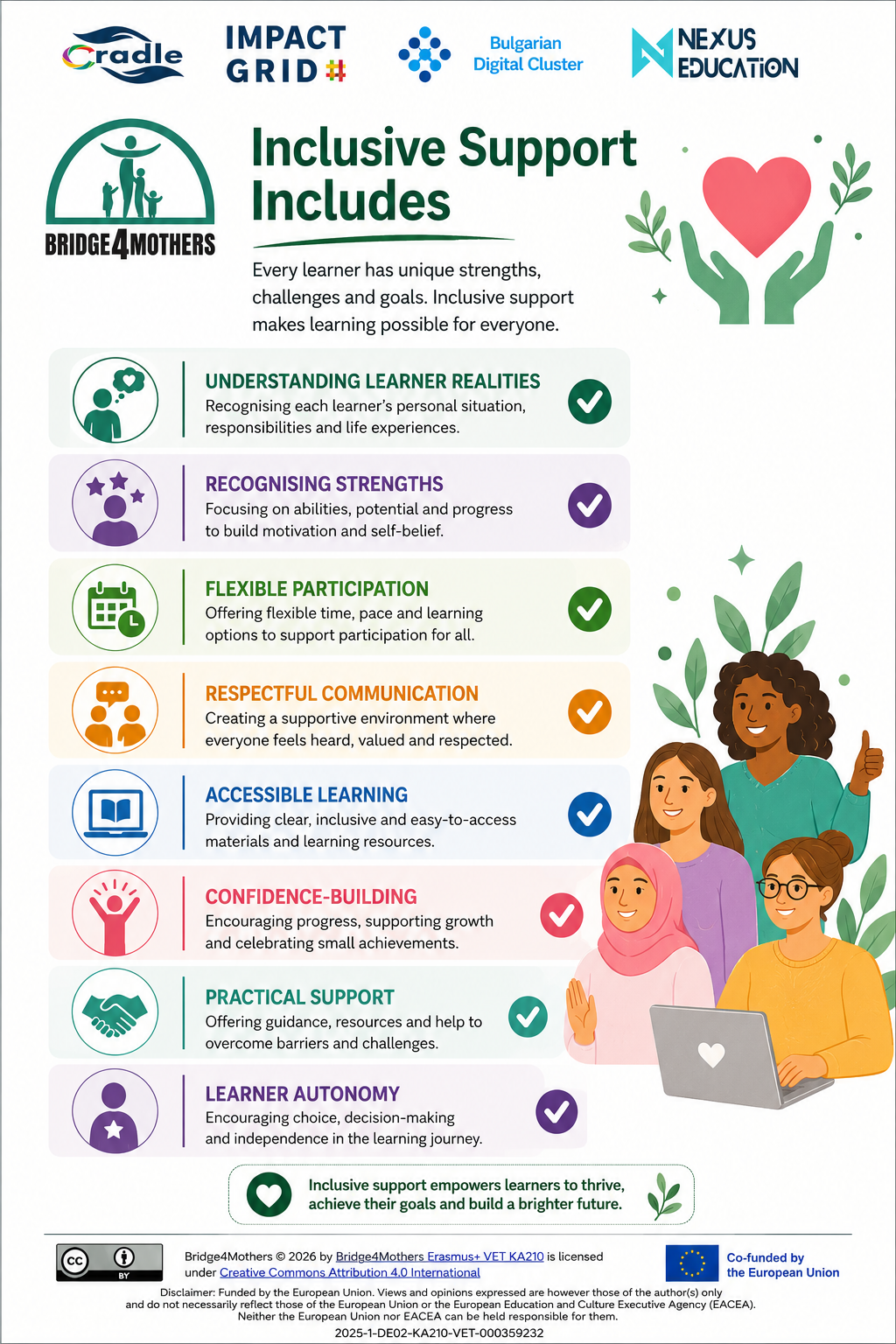
This module helps trainers understand the realities, strengths, and learning needs of vulnerable mothers participating in VET.
Vulnerable mothers may experience interconnected barriers such as:
-
caregiving responsibilities;
-
rigid training schedules;
-
financial pressure;
-
interrupted education;
-
limited access to childcare;
-
digital exclusion;
-
low confidence;
-
discrimination;
-
social isolation;
-
and uncertainty about returning to employment.
Trainers should not define learners only through vulnerability. Mothers may already possess valuable competences developed through caregiving and life experience.
These can include:
-
organisation;
-
adaptability;
-
multitasking;
-
resilience;
-
empathy;
-
negotiation;
-
time management;
-
and problem-solving.
-
-
-
-
By the end of this module, participants will be able to:
-
understand barriers affecting vulnerable mothers;
-
recognise existing strengths and transferable skills;
-
avoid stereotypes and deficit-based assumptions;
-
apply learner-centred approaches;
-
and adapt training to different participation needs.
-
-
-
-
-
-
Participants will:
-
demonstrate stronger awareness of learners’ realities;
-
identify strengths developed through life experience;
-
design more inclusive participation arrangements;
-
and communicate more supportively with vulnerable learners.
-
-
-
-
-
-
Estimated Learning Time
5–6 hours
-
-
-
-
-
-
-
Opened: Wednesday, 5 August 2026, 12:00 AMDue: Wednesday, 12 August 2026, 12:00 AM
-
Opened: Wednesday, 5 August 2026, 12:00 AMDue: Wednesday, 12 August 2026, 12:00 AM
-
Opened: Wednesday, 5 August 2026, 12:00 AMDue: Wednesday, 12 August 2026, 12:00 AM
-
-
-
-
-
Understanding the realities and strengths of vulnerable mothers is the foundation of inclusive PSL training.
-
-
-
-
-
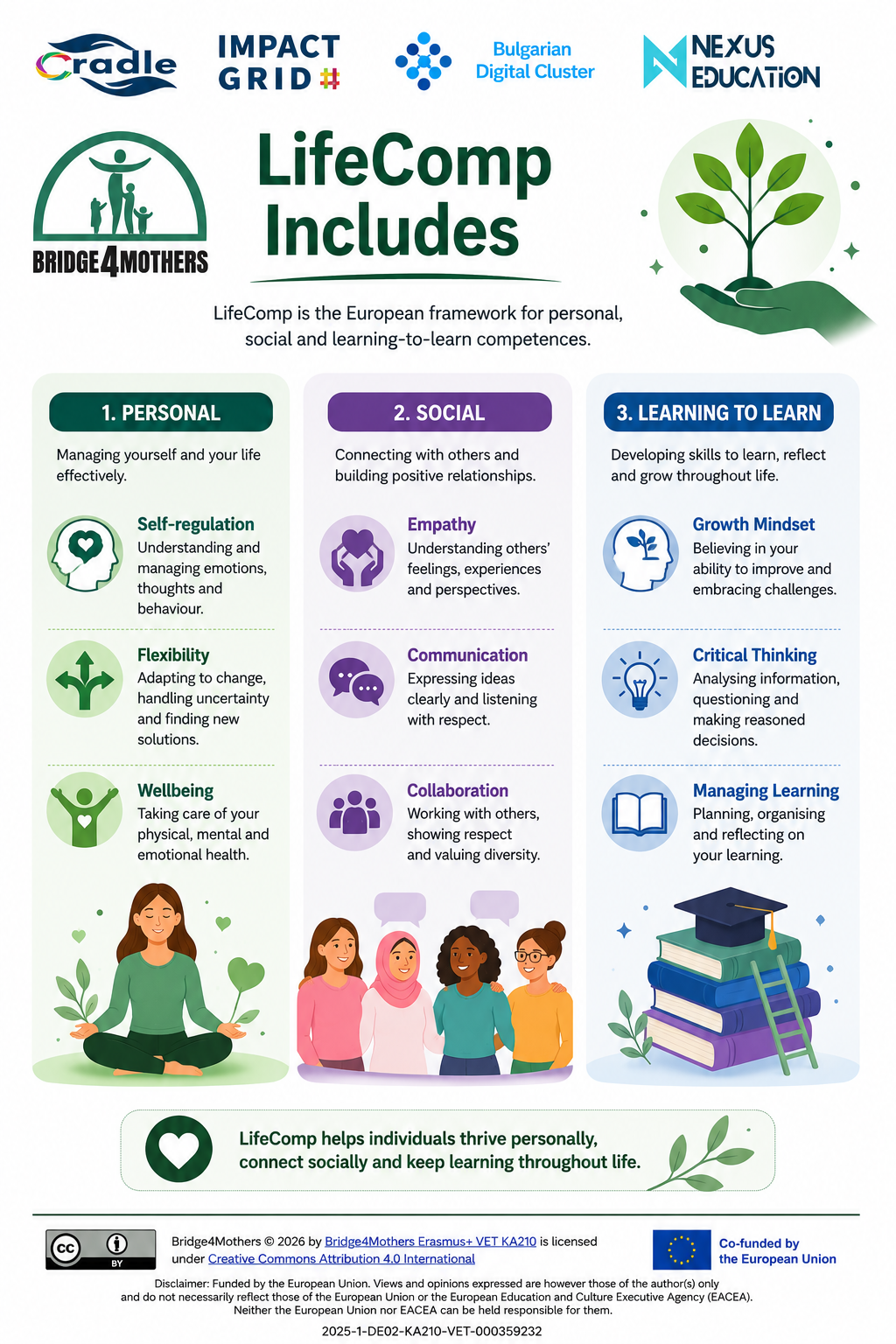
This module introduces Personal, Social and Learning-to-Learn competences and the LifeComp framework.
The three LifeComp competence areas are:
Personal
-
self-regulation;
-
flexibility;
-
wellbeing.
Social
-
empathy;
-
communication;
-
collaboration.
Learning to Learn
-
growth mindset;
-
critical thinking;
-
managing learning.
These competences can support vulnerable mothers in strengthening:
-
confidence;
-
resilience;
-
communication;
-
problem-solving;
-
career planning;
-
employability;
-
and participation in society.
-
-
-
-
Participants will be able to:
-
explain the three LifeComp areas;
-
connect PSL with social and economic inclusion;
-
recognise PSL competences developed informally;
-
design relevant PSL activities;
-
and connect learning outcomes with employability.
-
-
-
-
-
-
Participants will:
-
understand the LifeComp structure;
-
map lived experiences to PSL competences;
-
and create learning activities connected to real-life and professional contexts.
-
-
-
-
-
-
5–6 hours
-
-
-
-
-
-
-
PSL competences help learners recognise existing strengths and use them in education, employment, and everyday life.
-
-
-
-
-
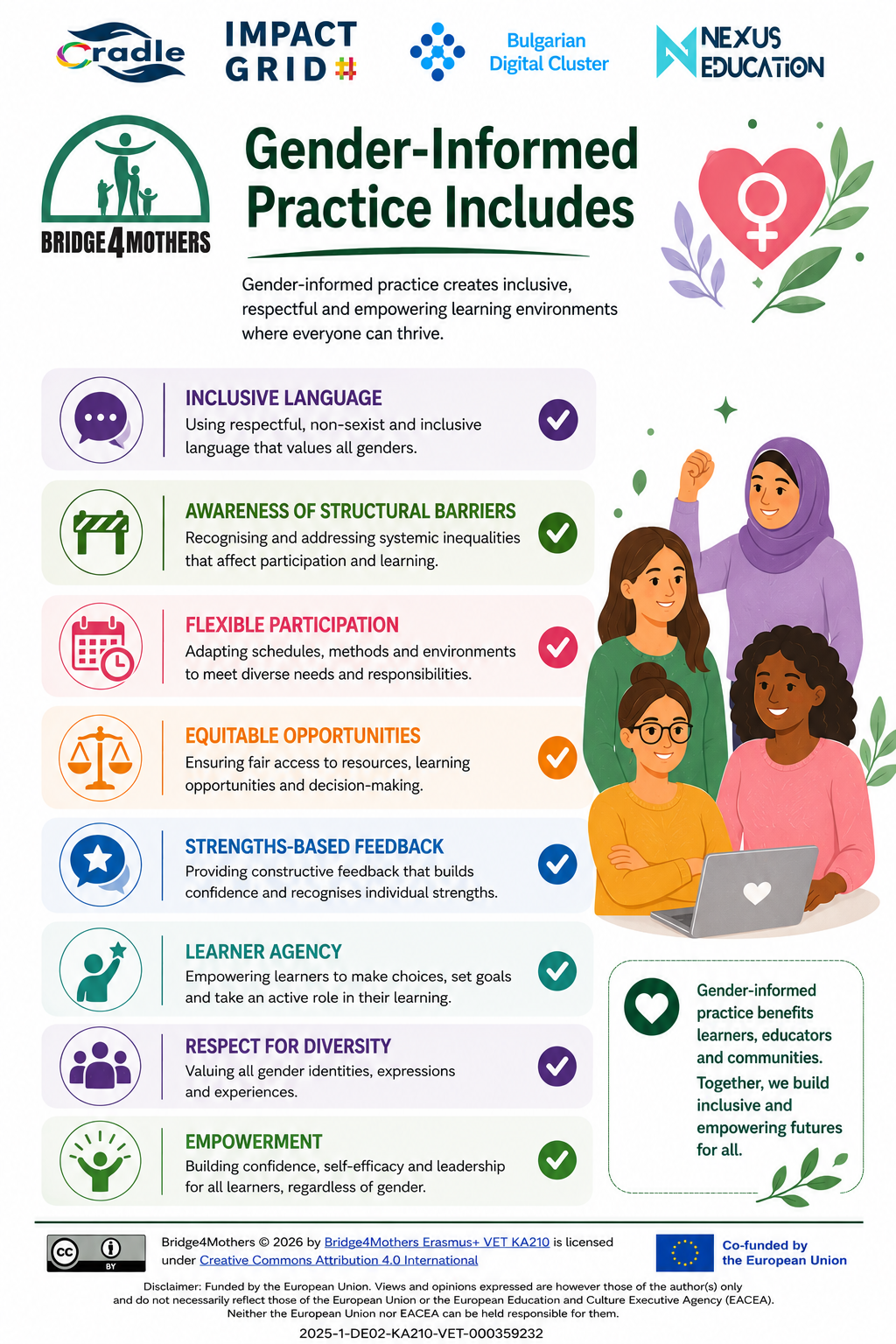
Gender-informed pedagogy recognises that learning participation may be affected by:
-
unequal caregiving responsibilities;
-
employment gaps;
-
financial dependence;
-
social expectations;
-
discrimination;
-
gender stereotypes;
-
and unequal access to time and resources.
A gender-informed trainer:
-
recognises structural barriers;
-
avoids assumptions;
-
uses inclusive language;
-
values lived experience;
-
provides equitable participation;
-
and supports learner agency.
-
-
-
-
Participants will be able to:
-
explain gender-informed pedagogy;
-
recognise bias and stereotypes;
-
use inclusive language;
-
adapt activities equitably;
-
and support empowerment and participation.
-
-
-
-
-
-
Participants will:
-
improve bias awareness;
-
strengthen inclusive communication;
-
and design more equitable learning experiences.
-
-
-
-
-
-
5–6 hours
-
-
-
-
-
-
-
Opened: Wednesday, 5 August 2026, 12:00 AMDue: Wednesday, 12 August 2026, 12:00 AM
-
Opened: Wednesday, 5 August 2026, 12:00 AMDue: Wednesday, 12 August 2026, 12:00 AM
-
Opened: Wednesday, 5 August 2026, 12:00 AMDue: Wednesday, 12 August 2026, 12:00 AM
-
Opened: Wednesday, 5 August 2026, 12:00 AMDue: Wednesday, 12 August 2026, 12:00 AM
-
-
-
-
-
Respectful communication, emotional safety, and learner-centred facilitation are essential for strengthening participation, confidence, and long-term learning success.
-
Respectful communication, emotional safety, and learner-centred facilitation are essential for strengthening participation, confidence, and long-term learning success.
-
-
-
-
-
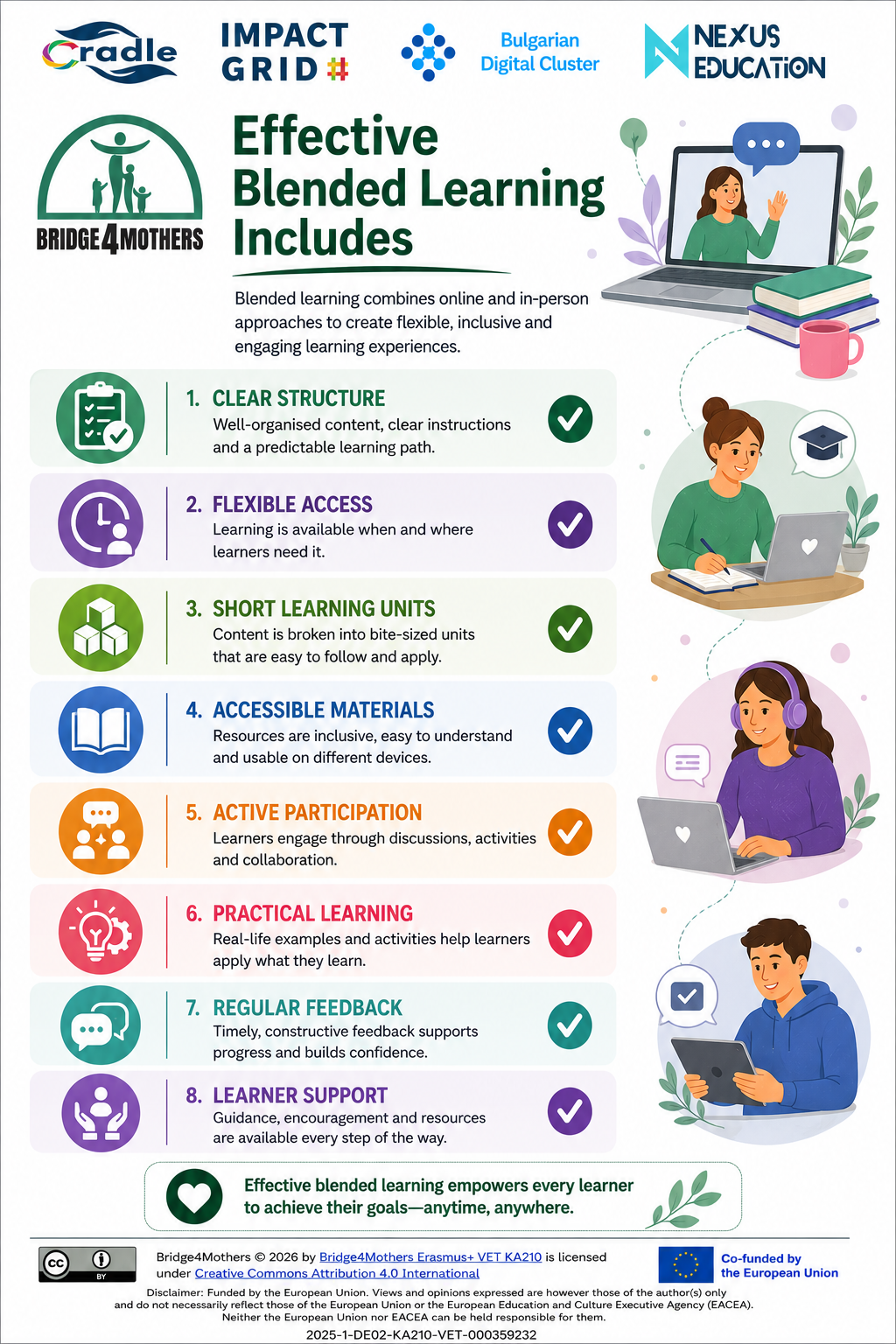
Blended learning combines:
-
in-person learning;
-
online learning;
-
independent activities;
-
and collaborative digital participation.
Flexible pedagogy is especially important for learners managing:
-
caregiving;
-
employment;
-
transport limitations;
-
emotional stress;
-
and changing availability.
-
-
-
-
Participants will be able to:
-
explain blended learning;
-
distinguish synchronous and asynchronous activities;
-
design flexible participation;
-
use Moodle effectively;
-
and maintain learning quality across different formats.
-
-
-
-
-
-
Participants will:
-
create blended PSL activities;
-
improve online engagement;
-
and provide accessible learning pathways.
-
-
-
-
-
-
6–7 hours
-
-
-
-
-
Opened: Wednesday, 5 August 2026, 12:00 AMDue: Wednesday, 12 August 2026, 12:00 AM
-
Opened: Wednesday, 5 August 2026, 12:00 AMDue: Wednesday, 12 August 2026, 12:00 AM
-
-
-
-
-
To complete Module 4, participants must:
View all learning materials
Participate in discussion forum
Complete Moodle practice activities
Submit blended lesson plan
Complete quiz/self-assessment
-
-
-
-
-
Flexible pedagogy is essential for supporting participation, confidence, and long-term engagement for vulnerable learners in VET.
-
-
-